Blogs
Blogs 
The Economics of Education: Comparing Direct Cost vs Opportunity Cost

Listen to this blog

Picture this: Two students graduate from the same college and want to get a master’s degree. One person travels to a new city, stops working, and starts studying full-time in a typical classroom program. The other person takes an online learning program and works during the day while finishing their degree at night.
Both students seem to be investing money into their education at first glance. But from the point of view of the economics of education, their choices have completely different effects on their finances.
Education involves more than just tuition fees and textbooks. Economists often divide the cost of education into two categories: direct cost of education, which includes visible expenses like tuition, accommodation, and study materials, and opportunity cost in education, which refers to the income, work experience, and career growth that students might give up while studying full-time.
Understanding these two types of costs helps students and professionals evaluate the true economic investment of higher education.
What Are Direct Costs in Education?
Let us begin by seeing what the direct cost in education is. These are what we call the visible expenses of education.
Examples:
- Tuition fees
- Hostel or rent
- Food
- Transportation
- Books and learning materials
- Laptop or software
Example:
If a 2-year MBA costs
₹8 lakhs tuition + ₹4 lakhs living expenses
Then the direct cost = ₹12 lakhs
This is what most people think is the total cost of education. Is it the case?
Unfortunately, no! Here is where opportunity costs come in.
What are Opportunity Costs in Education?
Opportunity cost, in simple terms, you give up when you choose one option over another.
In education, this usually means:
Income you could have earned if you were working instead of studying.
Example:
A professional earning ₹5 lakh per year quits their job to do a 2-year campus MBA.
They lose:
₹5L x 2 = ₹10L salary
So, their real cost becomes:
| Cost Type | Amount |
| Tuition + living | ₹12L |
| Lost salary | ₹10L |
| Total economic cost | ₹22L |
That ₹10L lost salary is the opportunity cost.
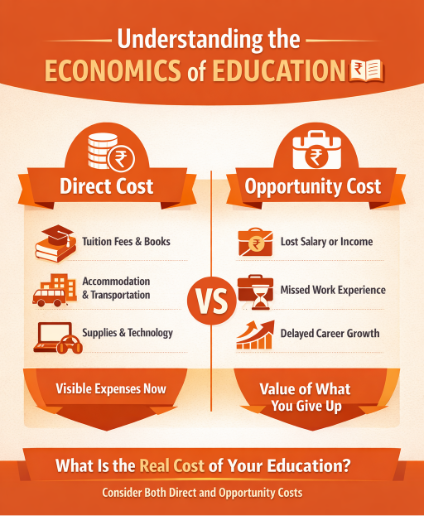
A Comparison of Direct vs Opportunity Cost In the Economy of Education
| Aspect | Direct Cost of Education | Opportunity Cost of Education |
| Definition | The actual money spent on pursuing education. | The value of what a person gives up in order to pursue education. |
| Nature of Cost | Visible and measurable expenses. | Hidden or indirect economic trade-offs. |
| Examples | Tuition fees, books, accommodation, transportation, and study materials. | Salary that could have been earned, work experience, promotions, or career growth delayed while studying. |
| Ease of Calculation | Easy to calculate because these costs are clearly listed. | Difficult to calculate because it involves estimating lost opportunities. |
| Time Frame | Occurs during the period of study. | Occurs when individuals sacrifice income or opportunities during their education period. |
| Financial Impact | Immediate financial expenditure. | Long-term economic impact is related to forgone income and experience. |
| How Students Usually View It | Most students focus on these costs while choosing a program. | Often overlooked even though it can be a significant part of the total cost of education. |
Factors Students Should Consider When Evaluating the Cost of Education
While understanding direct costs and opportunity costs is important, choosing the right educational path also depends on a few personal and financial considerations.
Money Matters Now
Students should determine if they have the ability to support school expenses (tuition, rent, books, etc.) at one time before initiating every process towards earning a degree.
Work Status
Students who are employed need to assess whether they need to take time off from their jobs to get another degree, or can they balance working and attending classes.
Degree Requirements
The degree and area of study must both meet the current job opportunities and long-term career prospects, and students must possess skills applied in their future career.
Campus Life Advantages
Many degree programs offered in classroom settings allow peer collaboration and engage in activities that will assist the students in developing their careers and improving themselves personally.
Lessons and Learning Styles
Some people prefer studying in a traditional classroom where they can attend classes with others and interact directly with instructors. Others prefer online programs that allow them to study independently, with the flexibility to manage their schedule and learn at their own pace.
Long-Lasting Value of Your Degree
Students should also evaluate how their degree will be of value to their future career prospects, salaries, and professional development.
Therefore, by considering these factors, students can make a more informed decision about the educational path they wish to pursue, while also understanding the direct and opportunity costs that may accompany that choice.
An Interesting Find: What Makes Students Drop Off in Online Programs and How Online Manipal Stands Out?
How Online Education Is Changing the Economics of Learning
As education systems change, online learning is becoming a good way for many students to deal with the financial realities of getting a degree. For people who work, it may not always be possible to leave their job to study full-time. Now that we know there is a cost, you should also know how much money it would save you to get an online degree.
Through online education, learners have the ability to develop new knowledge and skills while continuing to work. This has economic implications; particularly, one will incur less financial strain (e.g., moving costs, transportation, potentially losing income if one leaves work to go back to pursue education).
This is where platforms like Online Manipal help reshape how learners approach higher education. In addition, online degree programs enable students to work while working toward improving their education and balancing their work life and education.
Nonetheless, traditional on-campus learning has many opportunities for collaborating, learning to communicate effectively, and increasing self-discipline.
Conclusion
Understanding the economics of education means looking beyond tuition fees and considering the opportunities we may give up while pursuing a degree. Both direct costs and opportunity costs shape the true investment behind higher education decisions, as we now know!
So before choosing a degree, have you considered not just what you will spend, but also what you might give up along the way?
Prepare for your next career milestone with us


Explore Similar Blogs
View All
 06 Oct 2026
 5 mins
 18 Sep 2026
7 mins
18 Sep 2026
7 mins
 18 Aug 2026
8 mins
18 Aug 2026
8 mins
 18 Aug 2026
9 mins
18 Aug 2026
9 mins