
Listen to this blog

The APAAR ID (Automated Permanent Academic Account Registry) is a unique digital identity introduced under India’s education system to streamline student records. Often referred to as a One Nation One Student ID, in India it helps track academic progress across institutions. Students can also use this to login to access records and complete processes like APAAR ID registration and download through platforms like DigiLocker.
This is the best place to have the APAAR ID for students explained, including exactly how to create APAAR ID access, why it now matters for board exams and entrance tests, and how it connects to your Academic Bank of Credits (ABC ID). This groundbreaking initiative was introduced under India’s National Education Policy (NEP) 2020, paving the way for a digital academic ecosystem that simplifies how students store, access, and share their academic information throughout their academic life.
But what exactly is the APAAR ID meaning, and why does it matter so much right now? Let’s dive into this system in full, including the APAAR ID registration guide and the 2026 board exam updates every student should know about.
APAAR ID Meaning: An Overview
The APAAR ID is a 12-digit unique student ID that stores and manages a learner’s academic records digitally. It is linked with the Academic Bank of Credits (ABC), also known as the ABC ID, enabling seamless credit transfer between institutions. This ID serves as a centralized system for tracking academic records, managing credits, and simplifying transitions between institutions. It’s designed to provide every student with a permanent digital academic identity that consolidates their entire educational journey into one unified system, from school through postgraduate study.
By eliminating manual record-keeping and paperwork, the APAAR ID streamlines academic processes, making it easier for students, institutions, and governing bodies to access and verify academic credentials seamlessly.
We will know more about what APAAR ID and its importance in education in the coming sections is.
Importance of APAAR ID in Education
The NEP 2020 emphasizes flexibility, accessibility, and inclusivity in education. APAAR ID aligns perfectly with these goals, making education more student-centric and adaptable to individual needs. The APAAR ID is a pivotal tool designed to enhance academic experience for students. Here are the benefits of APAAR ID for academics:
1. Centralized academic record:
APAAR ID ensures that students’ academic achievements are stored in a single, easily accessible digital format. This centralized repository eliminates the need for multiple physical documents and reduces the chances of losing essential records.
2. Facilitates credit transfer:
The APAAR ID is directly linked to the Academic Bank of Credits (ABC) system, enabling students to transfer credits seamlessly between universities or colleges. This feature is particularly beneficial for students pursuing interdisciplinary courses or transferring institutions.
3. Supports lifelong learning:
As the world shifts toward continuous upskilling, APAAR ID plays a crucial role in helping students manage and update their academic credentials throughout their lives. This flexibility is key to adapting to rapidly changing career landscapes.
4. Reduces administrative hassles:
Gone are the days of lengthy paperwork and manual verification processes. With APAAR ID, institutions can easily verify a student’s academic history, saving time and effort.
You may be interested in understanding the online vs on-campus learning.
Is APAAR ID Mandatory for JEE Main, NEET, or CBSE Board Exams in 2026?
This is one of the most searched questions around APAAR ID right now, and the answer differs depending on which exam you’re asking about.
CBSE board exams: As of the 2026 exam cycle, CBSE has made APAAR ID mandatory for board exam registration, schools can only submit a student’s List of Candidates (LOC) if that student has a valid APAAR ID. This follows CBSE’s own finding that under 50% of students in affiliated schools had an APAAR ID as of 2025-26, prompting the board to make it fully mandatory from the 2026-27 academic session onward. If you’re entering Class 9 or 11, it’s worth confirming your APAAR ID status with your school well before LOC submission deadlines.
JEE Main: APAAR ID now has a dedicated field in the JEE Main application portal, entering and validating your 12-digit APAAR ID lets the system instantly pull your verified academic data from the National Academic Depository. However, per NTA’s official notification, it remains optional rather than strictly mandatory, candidates can still complete their application without it, though doing so may mean more manual verification later.
NEET: Similarly, APAAR ID is not mandatory for NEET registration, but providing it is recommended since it minimizes verification errors and speeds up processing.
The practical takeaway: even where it isn’t strictly compulsory yet, generating your APAAR ID early is worth doing before peak registration windows for any of these exams, since ABC portal traffic tends to spike right before deadlines.
Benefits of APAAR ID for students
Beyond the policy language, here’s what an APAAR ID actually changes for you, day to day, not in theory but in the moments that usually cause the most hassle during admissions, exams, or a transfer.

A Centralized System for the Students:
Think about how many marksheets, certificates, and achievement letters you’ve probably scanned and re-scanned over the years, one copy for this admission form, another for that scholarship application. With an APAAR ID, all of it sits in one verified digital record. You’re not digging through a folder (or a drawer) every time an institution asks for proof of something you already earned.
Faster Movement of Admissions:
When an institution can pull up your verified academic history directly instead of waiting on you to submit and re-submit documents, the whole admission process compresses. If you’ve ever sat through a slow, document-heavy counseling session, this is the part of APAAR ID that actually saves you real time, not just paperwork.
Smooth Credit Transfer:
This is where the link to the Academic Bank of Credits, your ABC ID, matters most. If you move colleges, take a gap, or shift from an offline to an online program, the credits you’ve already earned move with you instead of evaporating because your new institution has no record of them.
No more Fake Degrees!:
A tamper-proof digital record means a forged marksheet or a degree from a college that never existed is far easier to catch. That protects genuine students too, your real academic record can’t get lost in the noise of fraudulent ones, and employers or institutions verifying your background have something solid to check against.
No Hustle of Tracking Down Certificates:
The same APAAR ID follows you from school through a postgraduate degree. Years from now, when you’re applying for a job or a further degree, you won’t be tracking down a school you haven’t set foot in for a decade just to prove you studied there.
Taken together, these are the APAAR ID benefits that make it worth setting up early rather than waiting until an admission deadline forces your hand.
APAAR ID Application Process
The APAAR ID registration guide is an easy-to-follow process. For this, students must possess a valid Aadhaar card and create an account on DigiLocker for e-KYC purposes. Schools and colleges are required to initiate the registration process for APAAR ID cards only after obtaining parental consent.
Here’s a concise step-by-step guide for registration:
- Visit the Academic Bank of Credit‘s (ABC Bank) website.
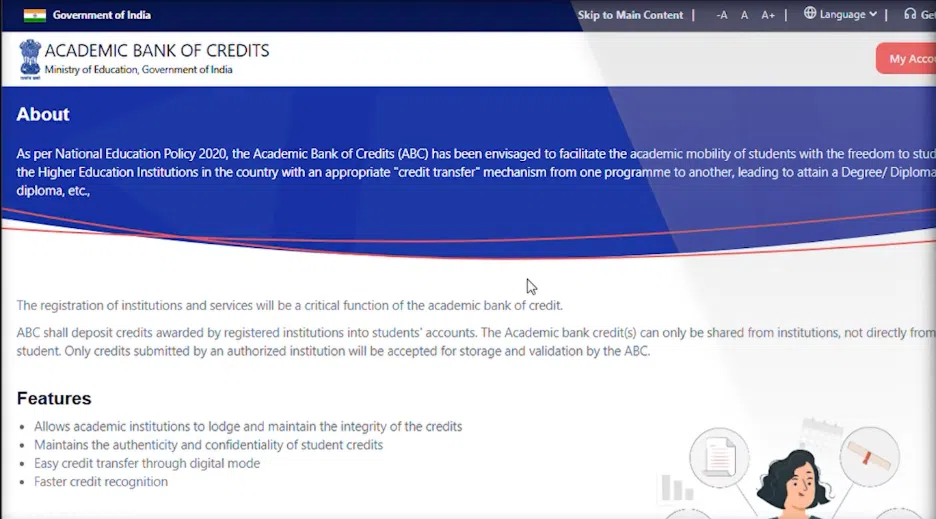
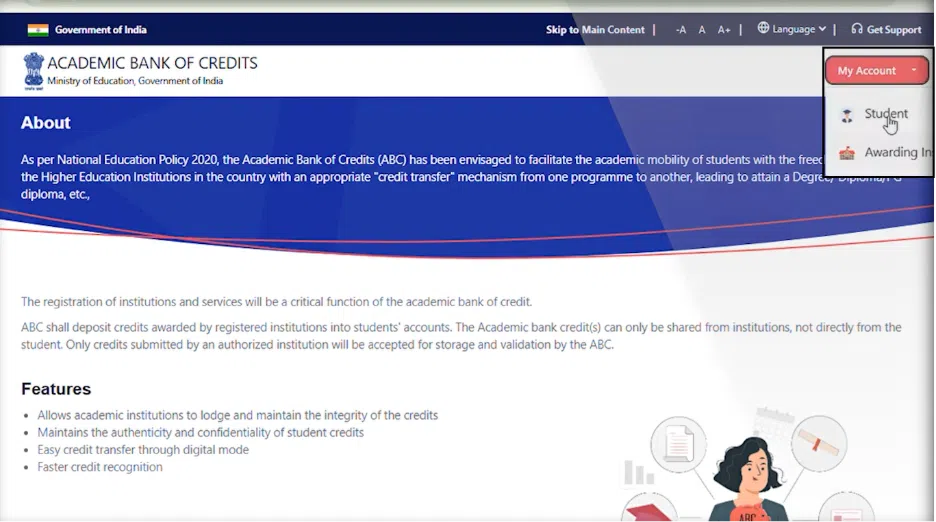
- Click on ‘My Account’ and select ‘Student’.
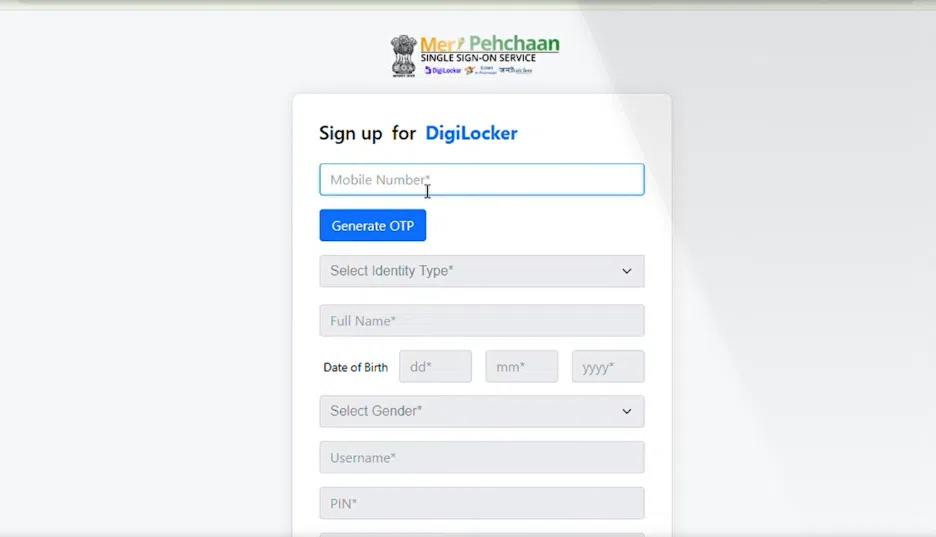
- Create a DigiLocker account by clicking ‘Sign up’ and entering your mobile number, address, and Aadhaar details.
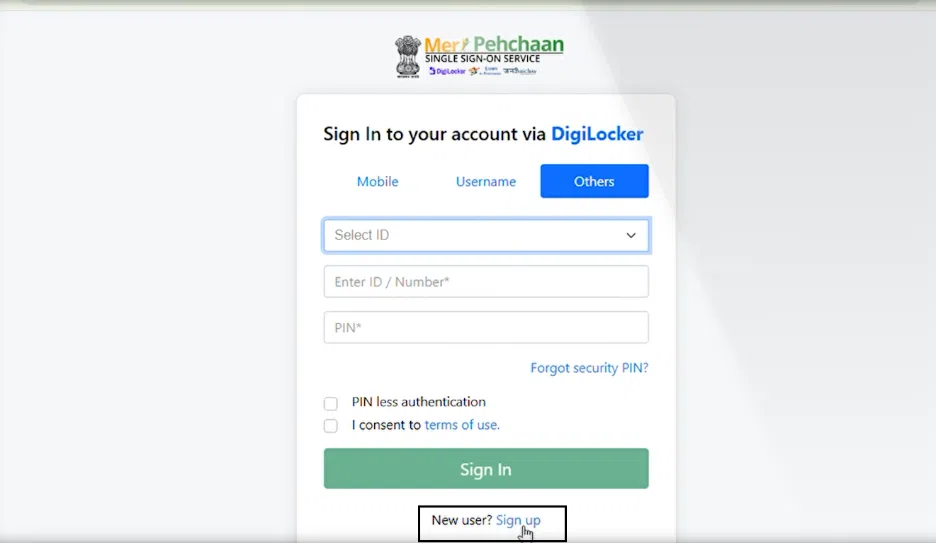
- Log in to your DigiLocker account using your credentials.
- Authorize DigiLocker to share your Aadhaar information with ABC for KYC verification by selecting ‘I agree’.
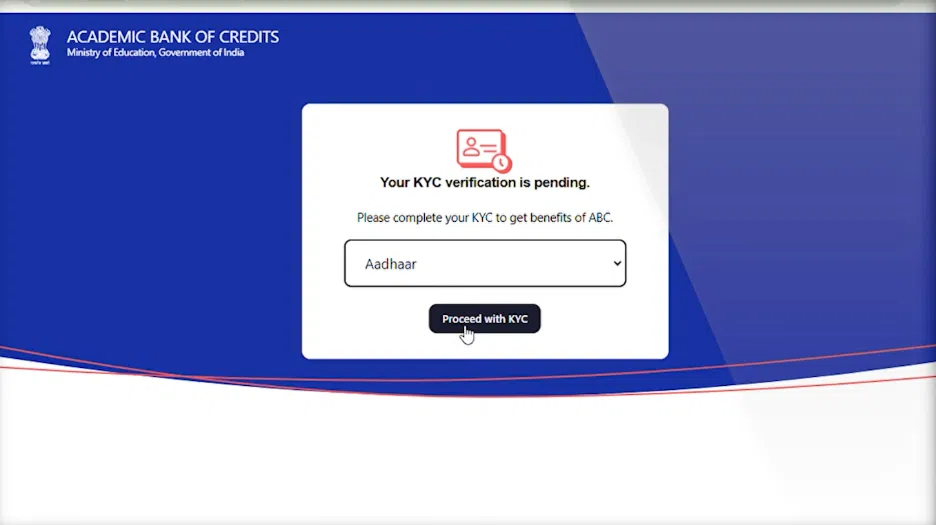
- Provide academic details such as your school or university name and the class or course you are enrolled in.
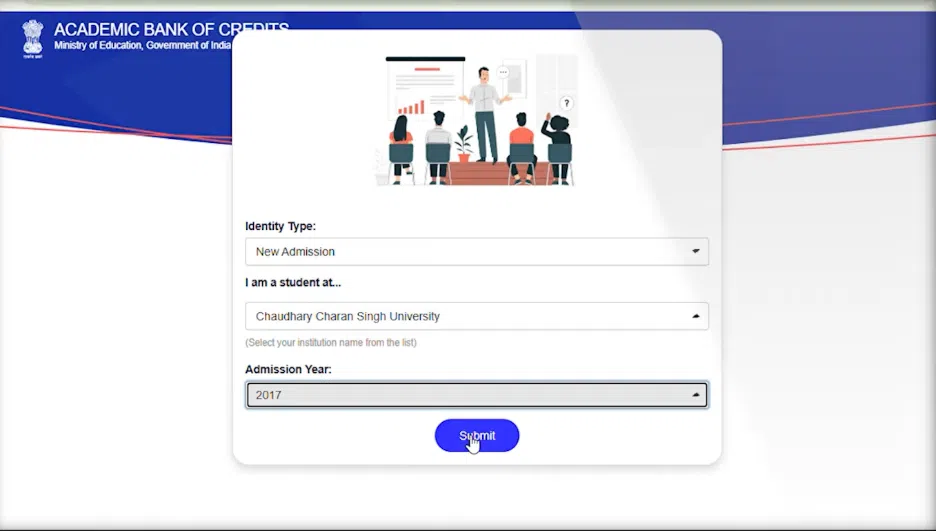
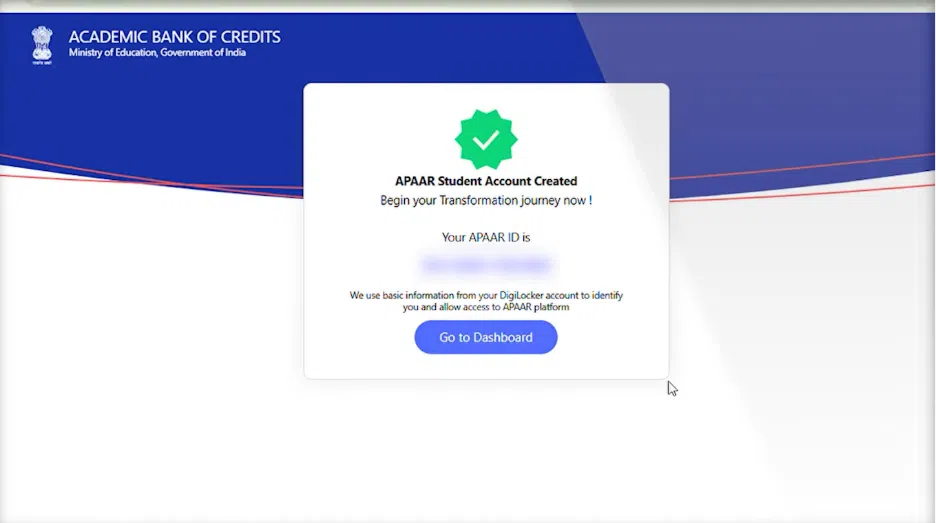
- Submit the form to generate your APAAR ID card.
Prerequisites before you start
Before generating an APAAR ID, two things need to be in place, and this is genuinely where most students get stuck:
- The student’s name in UDISE+ (Unified District Information System for Education Plus) records must match the name on their Aadhaar card exactly.
- The student’s PEN (Permanent Education Number) is required for APAAR ID generation.
If either of these doesn’t match, sort it out with your school or institution first, trying to register with mismatched records is the single most common reason APAAR ID generation fails or gets stuck in verification.
Differentiating between APAAR ID and Academic Bank of Credits (ABC)
While APAAR ID and ABC are closely related, they serve distinct purposes within the education ecosystem. Understanding the relationship between these two systems helps students navigate their academic journey more efficiently.
Here’s a quick comparison:
| Feature | APAAR ID | Academic Bank of Credits (ABC) |
|---|---|---|
| Definition | A unique identifier for students to track academic progress. | A digital repository that stores and manages credits earned by students. |
| Purpose | To provide a unified academic identity. | To facilitate seamless credit transfers across institutions. |
| Scope | Focuses on creating a permanent academic record. | Focuses on enabling academic credit mobility. |
| Key Use | Used to access and verify academic credentials. | Used to redeem credits for certifications or degrees. |
| Relation | Acts as an ID to access the ABC system. | Functions as a service under the NEP 2020 framework. |
| Governance | Issued and maintained by the National Academic Depository (NAD) | Operates under the University Grants Commission (UGC) and NEP 2020 guidelines |
Get to know everything about APAAR ID from its official site – india.gov.in/spotlight/details/automated-permanent-academic-account-registry-apaar
Conclusion
The APAAR ID is a genuine shift in how the Indian education system manages student records, bringing transparency, flexibility, and convenience to students and institutions alike. With CBSE now requiring it for board exam registration and JEE Main and NEET both building it into their application flow, it’s moved well past being an optional nice-to-have. By streamlining academic records and facilitating credit transfers, it empowers students to navigate their academic and professional journeys with far less friction.
Students pursuing online degrees from the universities offered under Online Manipal can have all their educational details transferred to a single ID. Explore our range of online degree programs to find the one that fits your goals, and remember: a valid APAAR and DEB ID are both required for admission into online degrees offered through Online Manipal.
Are you ready to embrace the future of education? Start by registering for your APAAR ID today and take the first step toward a seamless and enriching academic journey.
Also read: Your Complete Journey at Online Manipal: From Registration to Degree Completion
Frequently asked questions (FAQs)
1. What is the full form of APAAR ID?
APAAR ID stands for “Automated Permanent Academic Account Registry.”
2. Who can apply for an APAAR ID?
Any student enrolled in a school or higher education institution in India can apply for an APAAR ID.
3. Who is eligible for an APAAR ID, and what documents are required?
Any student currently enrolled at a recognized school or higher education institution in India is eligible. You’ll need a valid Aadhaar card, and your name and details in UDISE+ (for school students) or your institution’s records must match your Aadhaar exactly. Higher education students also need a DigiLocker account for e-KYC verification.
4. How is APAAR ID linked to the Academic Bank of Credits (ABC ID)?
APAAR ID acts as the gateway for students to access and manage their credits in the ABC system.
5. Is APAAR ID mandatory for all students?
It’s being rolled out as a mandatory system under NEP 2020. CBSE has already made it mandatory for board exam registration as of the 2026 cycle, with full mandatory status from 2026-27. For entrance exams like JEE Main and NEET, it’s currently recommended rather than strictly compulsory.
6. Can APAAR ID details be updated or corrected after creation?
Yes, if there’s a mismatch, most commonly a name or date-of-birth discrepancy between your Aadhaar and UDISE+/institution records, you’ll need to correct it at the source (your school’s UDISE+ records or your Aadhaar details) rather than editing the APAAR ID directly, since it pulls from those linked records. Note that some exam bodies, like NEET, don’t allow APAAR ID edits after fee payment and confirmation, so it’s worth verifying your details are accurate before submitting any exam application.
7. Can the id be used for international education opportunities?
While primarily designed for India’s education system, it has the potential for future global integration.
8. Is this id required for taking admission in online degrees offered at Online Manipal?
Yes, a valid APAAR ID and DEB ID are required for taking admission in online degrees offered by different universities under Online Manipal.
Prepare for your next career milestone with us