Listen to this blog

Imagine this:
You have successfully completed an online degree program, and the sense of satisfaction is well earned. While others were binge-watching Netflix, you were finishing projects, meeting deadlines, and staying committed to your goals. Each time you encountered a complex concept, you worked through it using real case studies and practical applications. That effort, discipline, and persistence are something you can genuinely be proud of.
Right now, you have your job application open, and an inner voice keeps telling you, “Will they think my online degree is real?”
It is high time this voice is silenced, because you have spent months sealing the deal to learn anything from anywhere without physical supervision. And that is one of the most valuable takeaways.
While traditional students had their scheduled lectures, you were the one trying to close the gap by accommodating your study time at 6 AM or pulling out a late-nighter after putting your kids to bed. While the on-campus students had their dedicated built-in study groups, you were building strong networking across time zones. When your on-campus students had their own campus momentum, you were building from the ground up your own structure, accountability, and motivation.
Reversing the Spider-Man quote, we can confidently say that “With great responsibility comes great power”. Being able to handle things on your own reflects well on your upcoming career journey and sets you apart as a trusted future employee for organizations.
As per latest statistics, it is viewed that over 87.4% of employers hired online degree holders in the past year. But this can still spark intimidating thoughts regarding interviews. And this well-curated playbook is going to help online learners to leverage their online learning experience as your biggest asset.
6 Ways to Prepare for Your Online Interview
Online learners can go through this 6-step guide and help themselves prepare for their future job interviews.
Step 1 – Own Your Online Learning Advantage
Skills Developed: Online learners should understand that they have unknowingly created a scenario in which they have their own structure that screams discipline, have developed digital fluency, unlocked the skill of adaptability, and expressed what real commitment is. All these are non-negotiable in modern work.
Being prepared for tough questions: Some of the most common questions employees face are “Is online education rigorous?” “Did you miss out on collaborations?”, or “Can you handle in-person environments?” These questions can be answered with sensible responses and specific tangible examples as below:
“Is online education rigorous?”
Our course lasted 20 hours per week for 12 months. The assignments provided were submitted and underwent a peer review alongside an instructor evaluation. We were assigned a capstone project involving a full-stack application that required professional coding standards. I will be more than happy to take you through the further complex milestones I tackled.
An interesting find: Master full-stack development with an online MCA
Step 2: Nailing Your Interview Setup
Being presentable and having a hassle-free setup are expected. And interviews can happen both offline and online. Hence, we have decoded how to prepare for both situations.
For Virtual Interviews
While most of the interviews may be offline, nowadays chances are that the first few rounds happen in a virtual setup. This will not be something alien for online learners as they have been dwelling at the online pace for a while now. Believe it or not, employers really appreciate and expect a hassle-free response during their online interview sessions.
Though learners have attended tons of video calls for their classes, online interviews need some optimization as follows:
Environment: A neutral background, preferably with no windows behind, is an ideal setting for online interviews. It is best when the camera angle is at eye level, not the laptop angle, looking up.
Lighting: When looking for a good spot with light, learners can face a window or use a lamp in front of them. This works effortlessly, providing excellent ventilation for the interview.
Audio: Utilizing headphones with a mic is a good option. Always test them beforehand. Closed windows with fans turned off will be a preferred choice to cut out other external sounds.
Video: Always have a quick hygiene check 30 minutes before the interview to confirm that the camera is working, that you can share the screen, that your microphone is audible, and so on. If the video appears blurry, wipe the camera with a clean cloth to remove any dust that has settled on it. This can amplify the camera experience, earning you extra brownie points for presentation.
If attending interviews through mobile screen, then
Cheat sheet: Have a document ready with your resume, job description, and key talking points visible. This can be best presented in bullet-point style, and the script-style writing can be avoided.
Audio: When attending an interview on your mobile phone, it is recommended to speak slightly more slowly than usual. And best of all, smile while talking, as this will also help you come through with the tone.
Note: A simple power cut can cause a major mishap while attending online interviews. It is advised to have the interviewer’s phone number in case something goes out of order.
For In-Person Interviews
Basics: Make sure you arrive at the interview at least 10-15 minutes early. Start by giving the panelists a firm handshake and making eye contact. It is always helpful to carry extra resumes and portfolios.
Body Language: Sitting up straight, slightly leaning forward, and not crossing your arms will provide a strong first impression. Being able to mirror the interviewer’s energy while staying authentic will tip the scales in your favor.
Read the Room: Always, while entering a room, make sure that you understand the mood board of the panel and adjust your behavior and responses accordingly.
Step 3: Answer Like a Pro
The STAR Method for Online Learners – Since online learning experiences are full of stories, these can be very well put up by using the STAR strategy. It basically stands for Situation, Task, Action, and Result. The example below will help learners get an idea about how to implement STAR for behavioral questions.
Question: How did you make virtual collaboration happen during your online learning journey?
Answer using STAR method:
Collaboration was one of the biggest traits that I learnt and have put into practice. Since I was admitted to the MA English program, our cohort once organized a virtual debate competition with participants across different cities (Situation). My core duty was to collaborate with my team so that the topic was researched, arguments were coordinated, and the points were presented in a full online setup (task).
For this, we used Microsoft Word to draft our pointers, then scheduled video calls to practice, and shared feedback in the group chat. It was fun and challenging at the same time, as we had team members from different time zones. We also summarized key points, and ensured every idea got spot on the table and was included in the final presentation (Action). On D-day, our team excelled with minimal confusion and received positive feedback from our faculty (results).
The biggest takeaway for me here was how structured communication and proactive collaboration can make virtual teamwork successful even in a very pressurized environment.
This way learners can tackle and provide high-clarity answers to their interviewers and stand out among others.
Common Questions to Prepare: There are some common questions that every online student will have to answer. Some of them are mentioned below:
- Why did you choose online education?
The course I selected was (program name), as it provided me with (mention the specific benefit) while also allowing me to balance my other commitments. One thing that really drew me to choose this course was ([instructor credentials, hands-on projects). The format of weekend classes really aligned with my schedule and helped me dive deep into the topics.
- How do you stay motivated without in-person accountability?
I love completing milestones. This is the same approach I applied to online learning, too. I made sure to create a workspace, establish a fixed schedule, and build accountability by sending my updates through MS Teams. Further, whenever my motivation dipped, I made sure to reconnect with my goals. One of the ways I kept going was by sharing my progress on LinkedIn, fostering positive peer oversight.
- Tell me about a time you had to figure something out independently.
During the course of my online degree, I encountered situations in which I faced a very complex subject and no live sources to figure it out. Hence, it led me to revisit recorded lectures and explore the topic further. This helped me develop my self-learning skills, elevate my confidence, and become a timely problem solver without any immediate guidance.
Note: The questions above are examples of commonly asked interview questions. While they may not appear in every interview, they offer students a helpful preview of what to expect and how to prepare.
Step 4: Showcase Your Portfolio
Make Your Work Visible: When preparing for an interview, always keep handy 2-3 of your best and strong projects ready to discuss. And keep the below points ready:
- Context: What problem were you solving?
- Your Role: What specifically did you do?
- Approach: Tools/methods used and why?
- Challenges: Obstacles encountered?
- Results: Outcome? (Quantify if possible)
- Learnings: What would you do differently?
Connect to Business Value: Always frame your answers in such a way that they are in business terms and not in technical specs. Below is one suitable example for this scenario
Instead of: “I built a machine learning model with 87% accuracy.”
Try: “I built a predictive model to identify at-risk customers before they churn. With 87% accuracy, this could enable proactive retention efforts. For a subscription business with $50 customer lifetime value, even 10% better retention could mean hundreds of thousands in revenue.”
Demonstrate Soft Skills: Apart from the hard skills, employers really emphasize soft skills. This should be built into candidates, and those who do showcase it really impress the interviewer. Some soft skills that are looked favorably on include communication, teamwork, problem-solving, time management, initiative & ownership, and emotional intelligence.
Also read: Crafting an impactful online portfolio: showcasing your skills in the digital era
Step 5: Ask Smart Questions
Always make sure to ask relevant questions to make the interviewer feel that you care about the company and the job.
About Learning Culture:
- What does success come across after six months? After a year?
- Does your company assist in professional upskilling?
About Remote Work (if relevant):
- Could I have a list of tools that your organization uses for collaboration?
- Can I have an idea about how remote work and flexibility are approached in your organization?
About the Role:
- “What’s the biggest challenge someone in this role would face?”
- “What would you want this person to accomplish in their first 90 days?”
About Culture:
- “Can you describe a recent project where the team had to adapt quickly?”
- “What do you personally enjoy most about working here?”
Step 6: The Follow-Up
Post-Interview Excellence: One of the best ways to ensure follow-ups are kept up to date is to send a thank-you email within 24 hours of the interview. This can also be an opportunity to share any additional relevant works if missed the first time, reiterate your interest and fit, and mention specific conversation points. Make sure the email is concise but personal.
Keep Improving: Not every interview will end with happy news. Sometimes it can go to the south side, leaving you disappointed. But that is not the end of the road. After each interview, record what worked and what did not. Highlight the questions that were hard to answer. Come up with better answers and update the portfolio based on feedback.
An interesting read: Building a Growth Mindset for Online Learning Success: The Science Behind Thriving in Digital Education
Final Thoughts
Your online learning journey isn’t something to explain away. It’s proof that you’re:
- Self-motivated enough to learn without external pressure
- Digitally fluent in ways that matter
- Adaptable to new environments and tools
- Committed to continuous growth
The future of work belongs to continuous learners. You’ve already proven you’re one of them.
Now go show them what you’ve got.
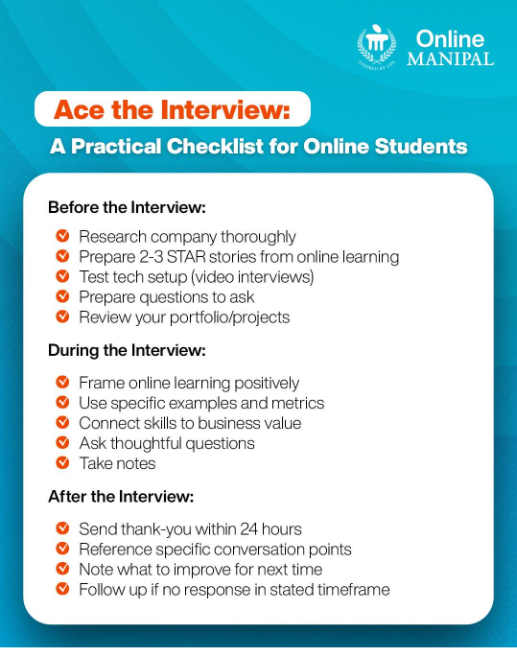
Quick Checklist
Prepare for your next career milestone with us