Blogs

Branches of Accounting: Purpose and Types

Listen to this blog

Take a single sale worth ₹1 lakh. To the financial accountant, it’s a line in the income statement. To the cost accountant, it’s a question: what did it actually cost to make? The tax accountant wants to know how much GST rides on it, and the auditor wants to see the invoice behind it. If something looks off, the forensic accountant is the one who traces where the money went. One transaction, five different lenses. That’s the quiet truth about the branches of accounting: they aren’t really separate subjects, just different questions asked of the same numbers.
Another truth is, not many of us are aware of accounting because it is a complex topic. You will often hear that there are three branches of accounting: financial, cost, and management accounting. That’s the classic textbook answer, but in practice the list is longer. As businesses, governments, and non-profits grew more complex, the fields of accounting multiplied to serve each of them. This blog walks through eight branches of accounting, what each one does, and where it fits in the Indian context. If you’re thinking about a career in this space, we’ll also cover where to start.
This blog will cover these concepts as simple as we can. So, here we go.
Different Types of Accounting and Their Purpose
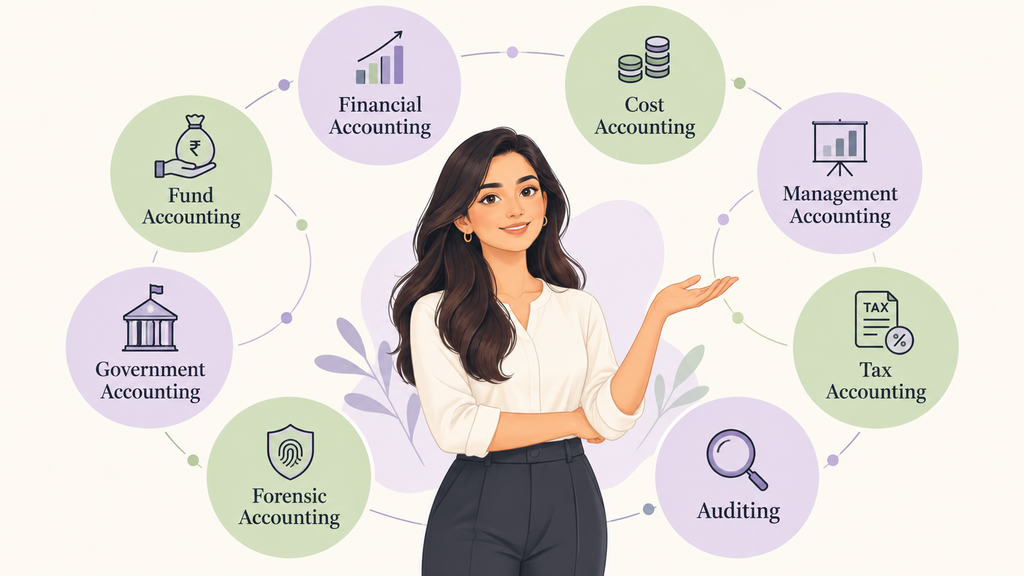
Accounting is classified into multiple branches based on its function and stakeholders. Here are some of the main branches of accounting and their significance.
1. Financial accounting
This branch of accounting is concerned with recording financial transactions and presenting financial statements to external users such as investors, lenders, tax authorities, and regulators like SEBI. In India, companies prepare their financial statements under the Companies Act, 2013. Applicable companies follow the Indian Accounting Standards (Ind AS), which are largely converged with the International Financial Reporting Standards (IFRS), while others follow the notified Accounting Standards.
Key features of financial accounting include:
- Preparation of financial statements like balance sheets, income statements, etc.
- Assisting entities in complying with the laws governing them, such as SEBI’s disclosure and reporting requirements for listed companies and public offers of securities.
- Helping firms access capital while keeping operations transparent, among others.
For example, when a listed company publishes its quarterly results, those numbers come out of financial accounting.
2. Cost accounting
It is a vital tool businesses use to establish the real cost of production. This makes it indispensable for manufacturing enterprises, retail businesses, and small businesses in India. Cost accounting enables companies to set competitive prices while staying profitable. Certain industries are even required to maintain cost records under the Companies Act, 2013.
How cost accounting operates includes:
- Identification of direct and indirect costs involved in producing goods
- Assisting in reducing costs
- Making budgetary decisions effectively
For example, a garment manufacturer working out the true cost of one shirt, covering fabric, stitching labor, electricity, and packaging, is doing cost accounting.
3. Management accounting
This is used as an internal tool for decision-making. Unlike financial accounting, it has no fixed statutory format because it is meant for managers, not outsiders. Indian firms depend on management accounting to analyze financial performance, create budgets, forecast, and improve operations. Along with financial and cost accounting, it completes the three branches of accounting most textbooks begin with.
For example, a retail chain deciding which store to expand and which to shut, based on monthly performance reports, is relying on management accounting.
An Interesting Find: What Is Corporate Accounting? Definition, Importance, Process, and Career Scope
4. Tax accounting
Tax accounting deals with computing tax liability, filing returns, and planning taxes within the law. In India, this covers direct taxes and indirect taxes like GST. Note that the Income-tax Act, 2025 replaced the Income-tax Act, 1961 from 1 April 2026, so it applies from Tax Year 2026-27 onwards.
The main objectives of tax accounting include:
- Complying with tax laws, including income tax, TDS, and GST
- Helping individuals and corporations plan their taxes and save legitimately
5. Auditing
This is meant to promote financial transparency and accountability. Under the Companies Act, 2013, a statutory audit must be carried out by a practicing Chartered Accountant (a member of the Institute of Chartered Accountants of India, ICAI) appointed by the company, in line with the Standards on Auditing issued by ICAI.
Audits are of various types, such as:
- Internal audits: These help assess risks and internal controls within the organization.
- External audits: Performed by independent auditors to confirm that financial statements present a true and fair view.
6. Forensic accounting
As financial fraud gets more sophisticated, forensic accounting is becoming one of the most in-demand fields of accounting. It is critical in uncovering malpractice within financial transactions. It combines accounting methods, legal procedures, and investigative techniques.
For example, tracing payments made to a fake vendor account created by insiders is classic forensic accounting work.
7. Government accounting
Government accounting ensures the efficient management of public funds. In the Indian context, the Comptroller and Auditor General of India (CAG) audits the accounts of the Union and state governments for transparency and accountability.
The primary purposes of government accounting in India include:
- It tracks government revenues and expenditures.
- Government bodies must follow the rules laid down for receiving and spending public money.
- It helps improve financial accountability in government-sponsored projects.
8. Fund accounting
Fund accounting is used by non-profit organizations such as NGOs, educational institutions, and religious trusts in India. It ensures that funds are used according to their intended purposes.
Fund accounting operates on some central functions, including:
- Keeping separate records for different types of funds
- Promoting transparency and accountability in financial management
Read More: Top Companies that Hire BCom Graduates
Start a Career in Accounting through Online Manipal
To establish yourself as an accountant, you first need a solid base education in finance. Online Manipal offers UGC-entitled online degrees from prestigious institutions like Manipal University Jaipur (MUJ), Sikkim Manipal University (SMU), and Manipal Academy of Higher Education (MAHE). Whichever of the fields of accounting you eventually want to specialize in, a strong foundation makes the move easier.
One worthwhile course to consider is the online BBA Finance & Accounting offered by Manipal University Jaipur (MUJ). It is designed to equip students with essential knowledge of finance and accounting, including financial management and corporate finance principles. You can also learn about:
- Taxation compliance laws
- Auditing standards and practices
- Data analysis techniques associated with financial decision-making
Besides, we have BCom Accounting with AI, which is a futuristic course and we have BCom Business Accounting and Taxation too for the learners.
For more details – Visit Online Manipal website.
The bottom line
A proper understanding of all the branches of accounting is essential for businesses, government institutions, and non-profits. Whether it’s financial reporting, cost analysis, or fraud detection, each of the branches of accounting plays its own part. The three branches of accounting give you the foundation, and the rest build on top of it. If you’re thinking about an accounting career, check out the online BBA in Finance & Accounting on our platform. It gives you a mix of theory and hands-on exposure, both of which help you stand out in this field.
Prepare for your next career milestone with us


Information related to companies and external organizations is based on secondary research or the opinion of individual authors and must not be interpreted as the official information shared by the concerned organization.
Additionally, information like fee, eligibility, scholarships, finance options etc. on offerings and programs listed on Online Manipal may change as per the discretion of respective universities so please refer to the respective program page for latest information. Any information provided in blogs is not binding and cannot be taken as final.

Explore Similar Blogs
View All
 26 Oct 2026
 7 mins
 16 Oct 2026
4 mins
 05 Oct 2026
5 mins
 28 Sep 2026
6 mins