
Listen to this blog

In God we trust; all others must bring data. — W. Edwards Deming
In today’s high-speed, data-heavy landscape, gut feelings are no longer enough to keep a company afloat. Organizations now lean on deep analytical insights to steer the ship. Whether we’re talking about predicting market shifts, nailing a pricing strategy, or building the next great algorithm, math is the invisible engine driving successful outcomes. Mathematical thinking for better business decisions is all about swapping guesswork for logic, using quantitative analysis and a structured mindset to map out the smartest path forward.
Modern tech firms and global brands are moving away from the traditional “shooting from the hip.” Nowadays, they are more prone to strategic, data-driven, and carefully analyze decisions. By prioritizing numbers and models over pure intuition, these companies use data-driven decisions using mathematical models to clear the fog of uncertainty, spot hidden patterns, and make strategic moves they can actually back up with evidence.
What is Mathematical Thinking?
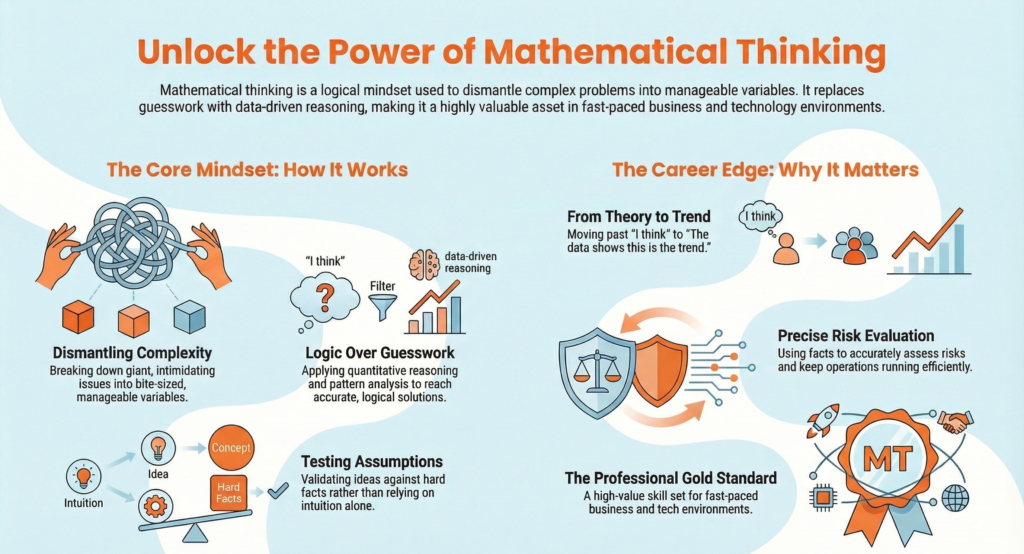
Mathematical thinking is defined as the process to approach problems logically, analyze patterns, apply quantitative reasoning, and use mathematical concepts to conclude accurate solutions. At its core, mathematical thinking isn’t just about doing long division in your head; it’s the ability to dismantle a messy problem using logic and numerical reasoning. It involves taking a giant, intimidating issue and breaking it into bite-sized variables to see how they influence one another.
In a fast-paced business or tech environment, this mindset is gold. It allows professionals to move past “I think this might work” to “The data shows this is the trend.” By testing assumptions against hard facts, teams can evaluate risks more accurately and keep their operations running like a well-oiled machine.
Does Math Improve Decision-making?
The short answer is: absolutely. Mathematical reasoning gives you a reliable framework to look at your options without the cloud of personal bias. Without a bit of math in the mix, decisions are often left to “gut instinct,” which can be dangerously inconsistent. Mathematics lets you put a price tag on risk and compare different strategies side-by-side. Let’s go through it section by section.
Also read: Top Courses and Careers for Maths Students
How does Mathematics Improve Decision-making in Business?
When leaders ask, “How can mathematics improve decision-making in business?” the answer usually starts with forecasting. Mathematical models allow companies to look into the future, estimating everything from next month’s inventory needs to next year’s market demand. The following points highlight how mathematics enhances decision-making.
- Helps analyze data
Mathematics helps organizations understand numbers, trends, and consumer behavior, leading to better decision-making and outcomes.
- Supports better predictions
Having mathematical models can help organizations predict their future sales cycle, the surge in demand it can generate, or the evolving market.
- Reduces risk
It is a great mitigation strategy to avoid risks, as it helps calculate potential risks before making an investment or launching new products.
- Improves planning
Mathematical thinking is a powerful tool for planning budgets, pricing, and resource allocation, helping them carry out operations effectively.
- Helps measure performance
Organizations use numbers and metrics to monitor progress and see if their strategies are working.
- Makes decisions more logical
Mathematical thinking promotes structured, evidence-based decision-making rather than relying solely on intuition.
How quantitative reasoning improves decision making
The secret sauce here is the ability to translate raw numbers into meaningful stories. How quantitative reasoning improves decision making is seen most clearly when a manager looks at a spreadsheet and sees a path to higher ROI. By using tools like probability and statistical analysis, you can cut through the noise of a “maybe” and find a “definitely.”
This approach is a lifesaver for risk management. Instead of crossing your fingers and hoping for the best, quantitative reasoning lets you calculate the odds of a specific outcome, giving you a safety net before you ever commit to a new strategy.
Role of Math in Business Strategy
The role of math in business strategy has become a major competitive advantage. In a world overflowing with data, the businesses that can calculate the best move usually win.
Take pricing, for example. Math helps businesses find that “Goldilocks” price point, high enough to maximize profit but low enough to keep customers running to a competitor. It also helps with resource allocation, ensuring that a company’s most valuable assets (time, money, and people) are focused on the tasks that will actually move the needle.
Importance of Mathematical Thinking in Technology
The importance of mathematical thinking in technology is impossible to ignore. Every piece of software you use is essentially a tower of logic and algorithms.
From the simple code running a website to the complex neural networks driving Artificial Intelligence, math is the foundation. Engineers use mathematical models to ensure systems are fast, secure, and scalable. In the world of cybersecurity, complex encryption, the stuff that keeps your bank account safe, is entirely built on high-level mathematical principles. Without this type of thinking, our digital world would essentially grind to a halt.
Data driven Decisions Using Mathematical Models
Today’s most successful organizations aren’t just collecting data; they are putting it to work. Using data driven decisions using mathematical models allows a company to simulate different “what-if” scenarios without spending a dime.
- Predictive Models: Help you see trends before they happen.
- Optimization Models: Figure out the most efficient way to ship products or schedule staff.
- Statistical Models: Reveal the “why” behind customer behavior.
These tools turn a mountain of raw data into a clear roadmap for action.
Conclusion
Mathematics isn’t just for the classroom; it’s a high-powered tool for anyone trying to navigate a complex market. From tech startups to global retail giants, the ability to think mathematically is what separates the leaders from the laggards.
By embracing mathematical thinking for better business decisions, you’re doing more than just “checking the numbers” – you’re building a smarter, more resilient organization. In a future that will only get more data-driven, the people who speak the language of math will be the ones calling the shots.
Prepare for your next career milestone with us