Listen to this blog

According to the Coursera Report on AI in Higher Education, 55% of students in India think AI usage in their studies will prepare them for future employment, versus a 39% global average.
This single insight reflects a larger shift happening amongst the learners. AI is no longer just a tool, but it’s becoming a core part of how students learn, think, and prepare for careers.
While the growing reliance on AI can make it overwhelming sometimes, especially at workplaces, the reality is more balanced. When it comes to higher education, both students and educators are reporting improved performance, better productivity, and more personalized learning experiences.
Emerging as the future of education, AI in higher education is no longer optional; it is now forming the foundation upon which modern education will be built. The issue is not going to be whether or not to adopt AI into your education; rather, the question to be answered is how well institutions will successfully implement AI into their coursework?
In this blog we will see the data that says how AI is evolving and getting integrated into higher education.
Why Students and Educators Are Embracing AI
Here are a few points that explains on why students and educators are embracing AI:
Personalized Education
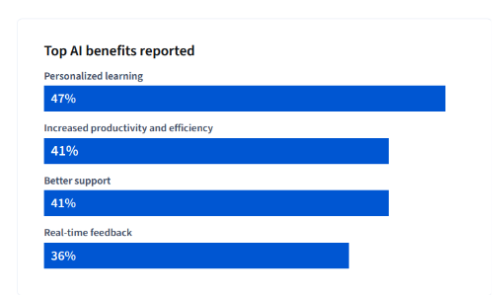
47% of both learners and educators say personalized learning is one of the greatest benefits of AI, as it allows the users to break down complicated ideas into simple explanation and demonstrate numerous ways of solving a problem, allowing the learner to grasp a subject more effectively without having someone else teach it to them first.
Productivity & Efficiency
41% of respondents believe AI enhances productivity by reducing the time to complete activities such as research and assignments; the academic process is simplified with the help of AI. What once took considerable time during assignments is now much easier. Students can instantly convert complex research jargon into plain, accessible language.
Support & Access
41% of respondents stated the continuous support that AI provides. For instance, AI assistants/bots provide answers around the clock to every question asked, help in organizing the learner’s work, and let the learner keep moving forward without having to rely on another person to provide input.
Feedback in Real Time
36% of learners and instructors noted that AI can provide instant feedback, allowing them to identify and correct their mistakes immediately, as well as enhancing their overall understanding. This is something traditional learning methods often lack, where students may have to wait before receiving feedback.
Read More: How is AI Redefining Personalized Learning?
Support Across Academic Tasks
AI is mostly used by students to conduct research (51%) or write papers (49%); however, they also rely on it to assist with their overall academic experience, including exam preparation, time management, and studying. It is easy to see how AI can aid in many ways throughout the learning process.
Strong Use of AI by Faculty
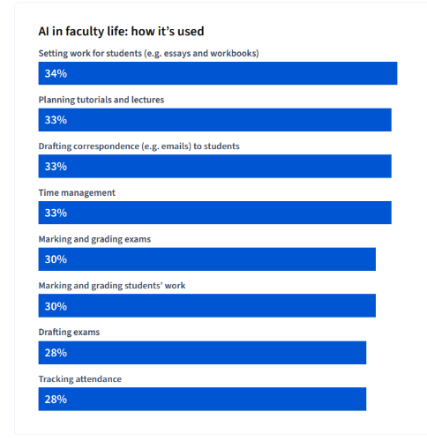
AI has been equally embraced by faculty members as 95% of educators report that they use AI at least on an occasional basis. Educators utilize AI applications to expedite their activities; whether it be planning lectures, creating assignments, managing their time, or grading.
Images from Coursera report
| Did You Know? If you are thinking students use AI without any balance and recklessly, that’s not true! This report has given us an insight that AI is not being used blindly; 63% of students use it for less than half of their tasks. This shows that students are adopting AI in a balanced way, using it where needed rather than depending on it entirely. |
Challenges and Risks of Increasing Adoption of AI
AI is now an inevitable part of higher education. It brings not just opportunities but also important challenges. Although many educators acknowledge the benefits of AI, there are growing concerns regarding academic integrity, loss of human interaction, and privacy issues with student data. Identifying these risks will help to ensure that AI enhances education while preserving the fundamental principles of education.
1. Reduced Human Interactions:
AI education raises another concern: the possibility of reduced interaction among people. While learning happens through obtaining information, there’s also an element of working collaboratively with others through discussions to develop interpersonal skills. Students who rely heavily on an AI tool may not develop as many relationships with peers and teachers, both of which are critical to the overall success of the student.
2. Dishonesty and Academic Integrity:
AI also poses a threat to academic integrity. Students can use AI to generate content quickly, creating an environment where most of them can use the tool to complete their assignments with little effort or understanding. For this reason, institutions should develop guidelines to ensure that AI can be used by students as a tool to support their learning, rather than as a way to exploit the system.
3. Privacy and Data Issues:
Another issue with AI tools is that they collect and analyze large amounts of user data. Therefore, privacy is a major concern in AI education. Both students and teachers need to understand how their information is collected, stored, and used, so that if they choose to utilize an AI tool to support their learning and teaching, they will have access to securely managed AI-enabled educational tools while protecting the privacy of their information.
| “Generative AI will be integral to the future of education, but its adoption demands careful consideration. Instead of letting AI replace creativity and critical thinking, we must guide people to use it as a tool to enhance these skills” – Dr. Jules White, Senior Advisor to the Chancellor on Generative AI at Vanderbilt University |
Top GenAI Courses Provided by Coursera
With Coursera’s AI-driven platform, students can now engage with each course in a more personalized way than ever before. For example, AI-powered features like real-time coaching, dynamic conversations, and simulation-based practice help learners grasp concepts and apply them in real live situations.
| Course | Provider | Key Skills |
| ChatGPT Foundations for Teachers | OpenAI | Generative AI, LLM Application |
| Generative AI: Empowering Modern Education | IBM | Artificial Intelligence, Data Ethics |
| AI in Education: Leveraging ChatGPT for Teaching | Wharton, OpenAI | ChatGPT, AI Personalization |
| Prompt Engineering for ChatGPT | Vanderbilt | Generative AI, Prompt Engineering |
| Google AI Essentials Specialization | AI Enablement, Operational Efficiency | |
| Generative AI for University Leaders | Vanderbilt University | Generative AI, Strategic AI Implementation |
| Foundations of AI and Machine Learning | Microsoft | Cloud Computing, Software Development, Data Integration |
| Generative AI for Everyone | DeepLearning.AI | Generative AI, Data Governance |
| Introduction to Artificial Intelligence (AI) | IBM | Data Ethics, Data Governance, AI Basics |
| AI Security | Infosec | Data Governance, Information Privacy, Risk Management |
How Online Manipal Supports AI-Ready Learning
The modern educational landscape has shifted to integrating artificial intelligence (AI) as an important part of both teaching and learning, and this has changed how students access the right tools and resources for learning.
Online Manipal is helping with this transition to an AI-ready learning environment by providing students with online programs with access to Coursera courses that focus on the skills associated with AI, and data analysis and the newest trends that are in demand.
Eventually, the certifications earned from completing these courses will improve the student’s resume, increasing their chance of being successful in a competitive job market.
Read More: Fueled by Passion, Powered by Coursera: The Journey of Our Champions
Conclusion
AI is clearly reshaping higher education, making learning more personalized, efficient, and future-focused. As students and institutions continue to adopt it, the real advantage will lie in how effectively it is used to build meaningful skills.
After all, are you just adapting to AI, or using it to get ahead?
Reference
Prepare for your next career milestone with us