Blogs
Blogs 
Step-by-Step Guide on How to Become a Chartered Accountant (CA)

Listen to this blog

Chartered Accountancy is one of those careers that genuinely commands respect, in boardrooms, courtrooms, and everywhere in between. If numbers, tax laws, audits, and financial strategy are your thing, this might just be the most rewarding path you can take.
But how to become a CA isn’t always clear-cut. The process is rigorous, the exams are demanding, and the journey takes a few years. That said, for those who stick it out, the payoff, that is in terms of career options, earning potential, and professional standing, is hard to match.
This article breaks down the entire CA exam process, from eligibility and registration to articleship and the final qualification, so you know exactly what to expect and how to prepare.
Who is a Chartered Accountant (CA)?
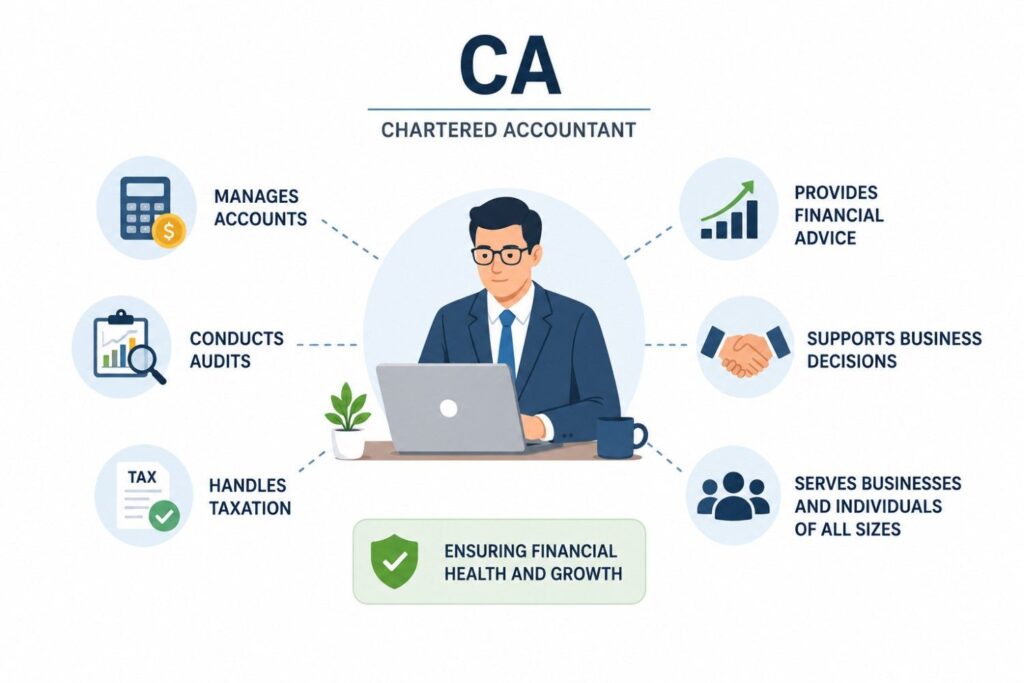
A chartered accountant is essentially the person whom businesses turn to when money gets complicated. They handle accounts, audits, tax planning, and financial advisory, for everyone from solo entrepreneurs to large corporations.
What makes the CA profession valuable isn’t just technical knowledge. A good CA in India helps organizations make smarter financial decisions, stay compliant, and plan ahead, not just report what’s already happened.
The demand cuts across industries too. Whether it’s taxation, auditing, management consultancy, or corporate finance, chartered accountancy as a career is sought after across sectors and business sizes. It’s one of those designations that doesn’t go out of demand.
Steps to Becoming a CA: The Complete CA Exam Process
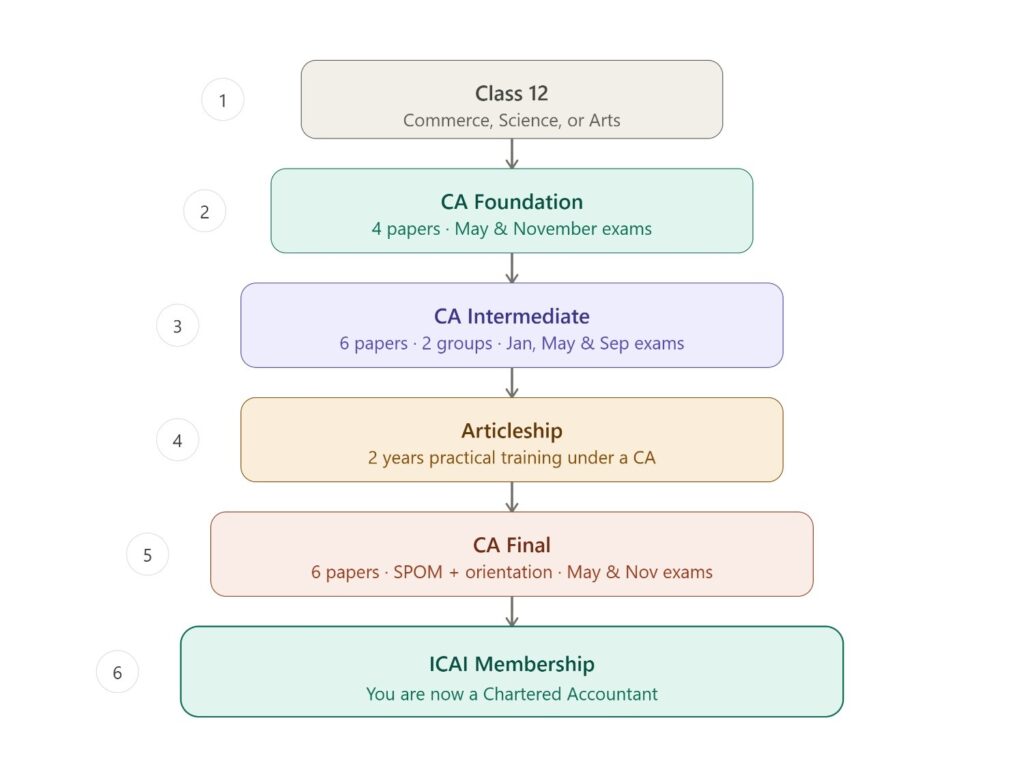
For anyone serious about how to become a CA, here’s the step-by-step breakdown of the full journey — from Class 12 all the way to ICAI membership..
1. Clear your Class 12 (Higher Secondary)
The CA preparation journey ideally starts right after Class 12. A Commerce background with subjects like Accounting, Economics, and Mathematics gives you a head start, but students from Arts or Science streams can pursue CA too. It’s harder without the commerce base, not impossible.
2. Register for the CA Foundation Course
The CA Foundation is the official entry point into how to complete the CA course. You can register after passing Class 12 and must complete a mandatory 4-month study period before appearing for the exam. Foundation exams are held twice a year — in May and November.
3. Clear the CA Foundation Exam
This is the first stage of the CA exam process. The Foundation has 4 papers (400 marks total). Subjects covered include:
- Principles and Practice of Accounting
- Business Laws
- Business Mathematics, Logical Reasoning and Statistics
- Business Economics
4. Register for CA Intermediate
Once you clear the Foundation, you register for CA Intermediate. Graduates with a Commerce degree (55%+) or other streams (60%+) can skip the Foundation and enter Intermediate directly through the Direct Entry route.
5. Clear the CA Intermediate Exam
This is where CA preparation gets significantly more demanding. The Intermediate level has 6 papers split across 2 groups of 3 papers each. Exams are held three times a year, January, May, and September. Subjects include:
- Advanced Accounting
- Corporate and Other Laws
- Taxation (Direct and Indirect)
- Cost and Management Accounting
- Auditing and Ethics
- Financial Management and Strategic Management
You need to clear both groups to proceed. Marks required are as shown below:
| CA Inter Passing Criteria | Requirement |
|---|---|
| Minimum marks in each subject | 40/100 |
| Aggregate for Group I (3 subjects) | 150/300 (50%) |
| Aggregate for Group II (3 subjects) | 150/300 (50%) |
| Aggregate for Both Groups | 300/600 (50%) |
6. Complete Your Articleship (Practical Training)
After clearing CA Intermediate, you begin a 2-year articleship under a practicing Chartered Accountant. This is a crucial part of how to complete the CA course, it’s where classroom knowledge meets real-world application across audit, taxation, finance, and compliance work.
7. Register for the CA Final Course
While doing your articleship, you register for the CA Final, the last stage of the CA exam process. Before appearing for the Final exam, you are also required to complete:
- Orientation Programme
- Soft Skills and Communication courses
- Self-Paced Online Modules (SPOM), which is mandatory.
8. Clear the CA Final Exam
The CA Final has 6 papers across 2 groups. Exams are held twice a year, in May and November. This is the toughest stage of the entire journey. Subjects include:
- Financial Reporting
- Advanced Financial Management
- Advanced Auditing, Assurance and Professional Ethics
- Corporate and Economic Laws
- Strategic Cost and Performance Management
- Multidisciplinary Case Study
9. Become a Member of ICAI
Once you’ve cleared the CA Final and completed your articleship, you apply for membership with the Institute of Chartered Accountants of India (ICAI). ICAI membership is what officially makes you a chartered accountant and allows you to practice or work in that capacity.
How Long Does It Take to be a CA?
The minimum time to complete the CA course under the current ICAI scheme is around 3.5 years, but realistically, it often takes 5 to 6 years depending on how many attempts a student needs at each level.
This is what how to complete the CA course actually looks like in terms of time- Foundation, Intermediate, a 2-year articleship, and then the Final. Clear everything in the first attempt and you’re looking at roughly 3.5 years. Take a few extra attempts along the way, and the timeline stretches accordingly.
So, there is no single answer to how long it takes to become a CA. It varies from person to person.
Online Manipal as a Platform for Professionals
If you are not certain about your career path or want to advance in knowledge, then choose Online Manipal. Online Manipal gives access to different types of online courses offered by Manipal University Jaipur (MUJ) and Manipal Academy of Higher Education (MAHE) that have UGC-recognized degrees.
An MBA in Finance or Data Analytics helps you upskill and learn more. Even BCom or MCom are useful if you are a CA aspirant. You can pursue these online degrees while having a part-time job since these programs are flexible, less expensive and easily obtainable. These degrees, along with a CA qualification can make your CV/resume look more professional and help you stand out as a top candidate.
An Interesting Find: How An Online M.Com Helps CA Candidates?
Career Opportunities After Becoming a CA
Once you know how to become a CA and clear that final exam, the career options are genuinely broad. This isn’t a one-track profession, but qualified CAs are in demand across corporate, government, and independent practice roles. Here are a few career opportunities after becoming a CA:
Internal or statutory auditor — Evaluate financial records, internal controls, and regulatory compliance for companies. Only qualified CAs are legally permitted to sign off on audits in India.
Tax consultant — Help individuals and businesses navigate GST, direct and indirect taxes, and compliance. Demand for CA-qualified tax professionals has grown sharply since GST rollout.
Also read: Difference between CA and ACCA
CFO or Finance Director — The natural leadership trajectory for experienced CAs, overseeing financial strategy, budgeting, and risk management at the organisational level.
Read more: Career After MBA in Finance
Financial analyst or investment advisor — Analyse market trends, evaluate financial data, and guide investment decisions for firms or individual clients.
Management consultant — Advise organisations on financial restructuring, strategy, and operational efficiency. Top consulting firms actively seek CAs for these roles.
Forensic accountant — Investigate financial fraud and suspicious transactions. One of the fastest-growing niches within chartered accountancy today.
Independent CA practice — Set up your own firm and serve clients across taxation, audit, and compliance, a path many CAs take after gaining experience.
Public sector and PSU roles — CAG, RBI, SEBI, and major PSUs hire qualified CAs for financial oversight and regulatory roles — solid options for those who prefer the public sector.
Also read: Government Jobs for MBA Graduates
Banking and fintech — Credit assessment, risk management, and financial compliance roles across India’s rapidly expanding digital finance ecosystem.
The bottom line
The CA exam process is demanding and there’s no sugarcoating that. But for those who see it through, the rewards are real. Prestige, job security, financial stability, and the freedom to work across industries, it’s a qualification that pays for itself many times over, whether you’re just starting out or making a mid-career switch.
If you’re looking to complement your CA preparation with a formal degree, Online Manipal offers flexible online programs from MUJ and MAHE that you can pursue alongside your work or articleship. It’s a practical way to how to complete the CA course journey while also building academic credentials, without having to put your career or life on hold.
Prepare for your next career milestone with us



Explore Similar Blogs
View All
 28 Sep 2026
 6 mins
 24 Sep 2026
23 mins
24 Sep 2026
23 mins
 17 Aug 2026
8 mins
17 Aug 2026
8 mins
 25 Jun 2026
13 mins
25 Jun 2026
13 mins