Listen to this blog

Have you ever seen computer vision at work? Believe it or not, it’s always at work, all around us!
Your phone unlocks at the glimpse of your face—that’s computer vision! And how do your favorite phone apps tag people in photos? That’s computer vision too—the technology behind all the magic happening, without you knowing it!
Machines can be taught to interpret pictures and videos just like humans, and this is how computer vision powers so many of our everyday experiences. With all this and much more, it can transform the way we travel, shop, and communicate in a visually driven world. This blog delves into the practical applications of computer vision in everyday life, showing how it seamlessly fits into our world without us even realizing it!
What is Computer Vision?
Before getting into the real-world application of computer vision, let’s take a moment to define what it really is for better understanding. Computer Vision is a subset of Artificial Intelligence (AI) that aims to train computers to analyze, interpret, and understand high-level information from digital images, videos, and other visual media.
Evolution of Computer Vision
Let us now look at the history of computer vision—a fascinating journey spanning many decades!
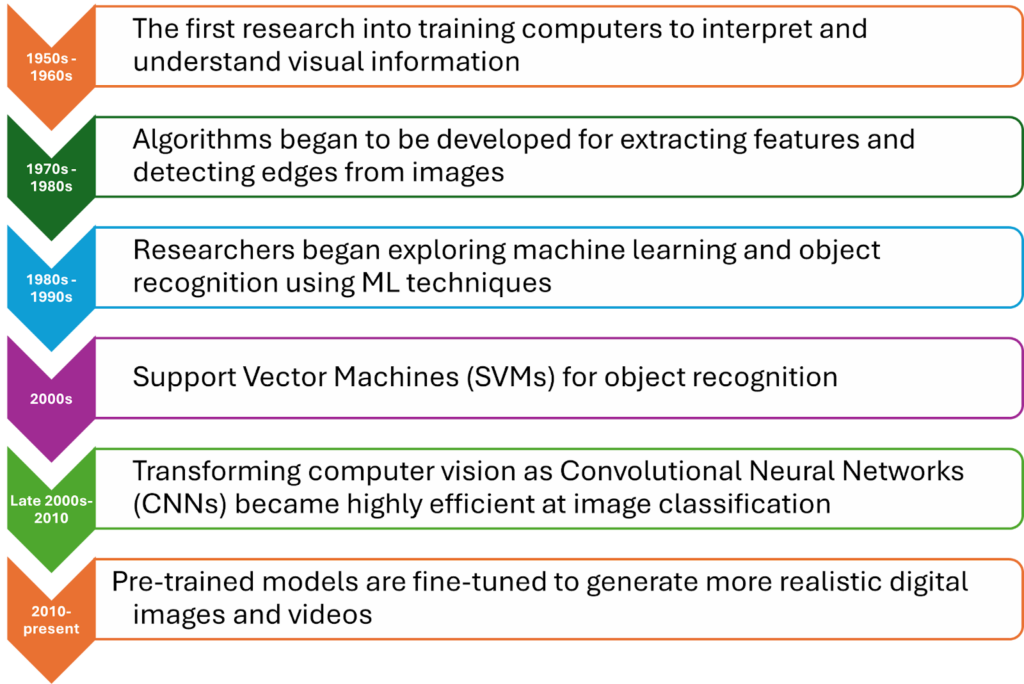
- 1950s – 1960s: It all started in the 1950s and 1960s, when the first research into training computers to interpret and understand visual information began.
- 1970s – 1980s: Algorithms began to be developed for extracting features and detecting edges from images.
- 1980s – 1990s: More advanced technologies emerged as researchers began exploring machine learning and object recognition using ML techniques.
- 2000s: The early 21st century saw the popularity of Support Vector Machines (SVMs) for object recognition.
- Late 2000s-2010: The Deep Learning revolution began in this decade, transforming computer vision as Convolutional Neural Networks (CNNs) became highly efficient at image classification.
- 2010-present: More advances in Deep Learning have been witnessed as pre-trained models are fine-tuned to generate more realistic digital images and videos.
How Does Computer Vision Work?
We learned what computer vision is and how it has evolved over the decades into what it is today, powering modern-day applications that make our lives easier. But let’s try to understand in more detail how exactly computer vision works, just as the human visual system does.
Listed below is a simple step-by-step procedure that explains the working of computer vision:
- Image capture: The computer vision process starts by acquiring digital images or videos from various sources, such as drones, cameras, and satellites.
- Data preprocessing: The next step after images are captured. They are then preprocessed to improve their quality and prepare them for further analysis.
- Feature extraction: At this stage, computer vision algorithms identify and extract meaningful features from preprocessed images.
- Model training: Several ML and Deep Learning models are trained on labeled datasets to learn relationships and patterns in the data. Some standard models include CNNs, Recurrent Neural Networks (RNNs), and Transformers.
- Prediction and decision-making: After training, models can classify or predict images, recognize faces, identify objects, track motion, or read text. They can then take the required action or offer insights based on what they “see”.
- Role of datasets, algorithms, and models: High-quality datasets are used in the computer vision process to provide the examples the computer system can learn from, and they are thus a vital component of the flow. Algorithms define how the system learns patterns. Models like CNNs and Vision Transformers help learn to identify, classify, or detect objects in new digital images.
- Why data quality matters in computer vision: Ensuring high-quality, accurately labeled, and diverse data directly affects the performance of the trained model. Poor or biased data can lead to lower accuracy, incorrect predictions, and unreliable results. However, clean, representative data ensures fairness and reliability in the real world.
Key Concepts Explained
To better understand the applications of computer vision in everyday life, it is essential first to grasp the field’s core concepts.
- Image recognition: A simple technique of computer vision that allows machines to identify and classify people, objects, places, or actions within a digital image.
- Object detection: A technique allowing computers to locate and identify several objects within a single digital image or video. It is commonly used in self-driving cars, face detection apps, and surveillance technologies.
- Facial recognition: This is a more advanced computer vision technique that identifies a person by assessing their unique facial features. These include the shape of their nose, the distance between their eyes, their jawline, and the like. The difference between face detection and facial recognition is that the latter not only “finds” a face; it also identifies “to whom the face belongs”.
- Image classification: In this computer vision technique, a system assigns a label to a digital image based on its content. For instance, it can determine whether an image includes a car, a cat, or a pedestrian.
- Video analysis: This computer vision concept enables computers to track movement across multiple video frames and can be highly useful for monitoring traffic and recognizing activity for surveillance purposes.
- Computer vision vs image processing: Computer vision is the technique of enabling machines to learn what an image contains. Image processing, on the other hand, improves digital images, making them more visually appealing to machines and humans.
- Importance of annotations and labeled data: They enable machines to correctly interpret digital images by providing clear examples of what each visual element represents.
Real-World Examples of Computer Vision
Computer vision can be further understood by sharing some everyday examples and case studies. Shared below are a few examples of real-world applications of computer vision for your better understanding:
Smartphones
This is a classic example of computer vision being used in modern technological features that make our lives brighter and easier. Some of the key features using the computer vision technique are:
- Face unlock: Using computer vision, this app feature on smartphones identifies and verifies the phone user via facial recognition to ensure secure and authorized access to the device.
- Camera filters and portrait mode: Yet another example of the use of computer vision to detect faces, depth, and edges in real time. Using computer vision, smartphones can blur backgrounds in digital images, apply effects, and enhance the image subject to give the photo a professional appearance instantly!
- Photo tagging and search: Computer vision enables the app to recognize faces, scenes, and objects in digital images. It also allows phone apps to automatically tag people and enable users to quickly find photos by using keywords such as names or locations.
Security Systems
- CCTV surveillance: Computer vision is used to track movements, detect faces, and identify unusual activities in real time.
- Facial recognition: This feature uses computer vision to analyze unique facial features and match them against stored data, which can be highly useful for identity verification at airports, banks, and other locations.
- Intrusion detection: Computer vision is used to monitor restricted areas and detect unauthorized movement in real time. This enables security teams to respond promptly and prevent potential threats.
Healthcare
- Medical imaging (X-rays, MRIs, CT scans): Computer vision can help analyze medical scans to highlight abnormalities at early stages, enabling medical teams to detect severe conditions or diseases in patients well in time.
- Disease detection and diagnostics: By identifying anomalies and specific patterns in medical images and patient data, healthcare professionals can diagnose early, improve accuracy, and plan treatments more effectively.
- Patient monitoring: Computer vision can help track patients’ vital signs, movements, and behavioral changes in real time.
Retail
- Cashier-less stores: Computer Vision has made its way into the retail industry, too. One of the essential applications of computer vision in everyday life is seen in retail stores that use computer vision rather than cashiers to track products customers pick up or return. This facilitates automatic billings and a comfortable checkout experience for customers.
- Inventory management: Computer vision can be used to monitor daily stock levels and track products on shelves in real time.
- Customer behavior analysis: This is a handy example of computer vision in the retail sector, where it helps businesses understand shopper behavior by tracking their movements, browsing, and purchases to identify common patterns and triggers that drive shopping.
How Online Manipal Helps Learners
From powering real-world applications such as smartphones and retail stores, computer vision is rapidly shaping the future. It is becoming an integral part of everyday services and applications in the real world, making people’s lives more innovative and more convenient. Online learning platforms such as Online Manipal are helping immensely in this revolution by equipping aspiring learners with the skills to use computer vision technology in everyday life.
Professional degree programs, such as the Online MSc in Data Science, are available from Manipal Academy of Higher Education (MAHE). The two-year postgraduate course is designed to make students job-ready with the requisite specialized skills in the field of data science and unlock various rewarding placement opportunities.
Some key job profiles are available across several sectors, including banking and financial services, retail and e-commerce, and pharmaceuticals.
Conclusion
Computer vision quietly but significantly powers everyday technologies in a world rapidly driven by AI. From unlocking our smartphones to detecting fraudulent activity in digital payments and even tagging photos with friends, computer vision seeps into our everyday lives, ensuring convenience and shaping the world around us.
Become a part of this significant revolution by learning essential skills and specialized knowledge in computer vision through the Online MSc Data Science program on Online Manipal. Enjoy the comfort of learning from home and prepare yourself for the future!
Prepare for your next career milestone with us