
Listen to this blog

Deciding which degree to pursue after class 12 is one of the most common sources of confusion for students stepping out of school and into university life. Making things trickier, several popular choices can prove equally rewarding for long term career growth. A Bachelor’s degree in Economics, for instance, is just as popular among students as an undergraduate course in Political Science. There are, of course, some real differences between the two that can help you make an informed choice at this stage of your journey.
This blog covers BA Economics vs BA Political Science in detail, so you can weigh both paths clearly.

What is BA Economics?
A BA in Economics is typically a three-year undergraduate program built to help students understand the fundamental concepts of the subject. It also equips them with the skills to apply economic theories and concepts to real world situations, from market behavior to public policy. Students often start researching which is better economics or political science after 12th right around the time they are shortlisting colleges, so it helps to understand each degree on its own terms first.
An Interesting Read: Which BA Course Is Best for UPSC? Top Specializations for IAS Aspirants
What is BA Political Science?
This is also a three year undergraduate degree, designed for students with a genuine interest in politics, both at the national and international level. The course covers a wide range of topics centered on government structures and the broader political landscape.
Read More: Top government jobs for political science graduates
Course curriculum: BA Economics
One of the key things to look at while weighing economics vs political science is the curriculum each degree actually covers. Here is a semester wise breakdown of what a typical BA Economics program includes:
| Semester | Subjects |
|---|---|
| 1 | Nature & Scope of Economics, Inductive & Deductive Logic, Merit & Demerits, Cardinal & Ordinal Utility, Market Demand-Supply Equilibrium |
| 2 | Perfect Competition Characteristics, Market Equilibrium, Total, Marginal & Average Revenue, Concept & Classification, Price & Output Determination for Firm & Industry |
| 3 | Natural Resources, Land, Water, Forest, Demographic Features, Population Distribution, Agriculture: Nature & Importance, Trends in Agriculture Production & Productivity |
| 4 | Irrigation, Power, Transport, Communication, Human Infrastructure of the Indian Economy, Housing & Sanitation, Analysis of the Current Five-Year Plan, Natural Resources – Forest, Water & Minerals |
| 5 | Concept of Accelerator, Keynesian Theory of Employment, Classical Theory of Employment, Aggregate Demand & Supply Functions, Simple Investment |
| 6 | Inflation, Deflation & Recession Principle of Maximum Social Advantage, Canons of Taxation, Principles of Public Debt & Methods of Redaction, Public Finance in India |
Course curriculum: BA Political Science
Here is a look at the subjects covered in a typical BA Political Science program. One of the primary differences in any economics vs political science comparison is that Political Science is usually offered alongside two other subjects, English and Sociology, giving students a broader, interdisciplinary base across all three domains. The table below reflects the verified, current semester wise curriculum for the Online BA in Political Science offered by Sikkim Manipal University (SMU) on the Online Manipal platform.
| Semester | Subjects |
|---|---|
| 1 | Foundations of Political Science; Introduction to Sociology; Indian English Literature; Communicative English; Natural Science |
| 2 | Political Theory; Sociology in India; World Literature; Functional English; Environmental Studies |
| 3 | Comparative Political Analysis; Rural Sociology; Essays and Poetry; Universal Human Values; Digital Fluency |
| 4 | Classical Indian Political Thought; Theories of International Relations; Political Economy; Urban Sociology; New Literature in English |
| 5 | Political Processes in India; India’s Foreign Policy in a Globalized World; Human Rights; Social Problems in India; Children’s Literature |
| 6 | United Nations and Global Conflicts; Public Policy and Administration in India; Gender and Politics; Sociology of Change and Development; American Literature |
Careers after BA in Economics
Students graduating with a BA in Economics can apply for a wide range of rewarding roles. Looking at where these graduates typically end up also helps clarify the practical side of the BA Economics vs BA Political Science decision, since career outcomes are often the deciding factor once the initial economics vs political science debate settles down. Here are few career options for BA Economics graduates:
Securities Trader:
They are also referred to as stock traders and buy and sell assets that can be traded. These include bonds, digital currencies, and stocks for individual or organizational clients in return for a commission. Security traders can earn around, ₹14 lakh, comprising an average base salary of ₹9 lakh and an additional ₹5 lakh in bonuses and incentives.
Actuary:
Uses statistical and mathematical skills to evaluate and reduce financial risk for a company. Professionals in this role earn an average base salary of around ₹12.5 lakh per annum, with bonuses and other incentives taking the average total annual compensation to approximately ₹14.5 lakh.
Economists:
They are responsible for conducting detailed studies of statistics and data on economics for analyzing and interpreting current trends. They then use their findings to offer advice to governments, business organizations, and individuals on topics of economics. Professionals in this role earn an average total annual compensation of around ₹14 lakh, including an average base salary of ₹12 lakh and approximately ₹2 lakh in bonuses and other incentives.
Auditor:
They evaluate the financial records of individuals and organizations, report the findings to the concerned stakeholders, and assess any potential financial risks involved for the organization.
Average annual salary (approx): INR 7 lakh per annum
Financial Advisor:
They understand the financial objectives of a client and offer guided assistance and support in devising plans for their achievement.
Here is the average annual salary (approx) of financial advisors, ₹4.7 L/yr – ₹5.2 L/yr
Careers after BA in Political Science
There is no shortage of strong career options after BA Political Science in India. Here are some of the most preferred paths for graduates:
International Development Officer:
They are responsible for executing various programs aimed at the development of developing nations in terms of their overall health standards, economic prosperity, and equitable distribution of essential amenities.
For professionals with 4-12 years of experience, average annual salary (approx) is ₹17.1 L/yr – ₹18.9 L/yr with 4 – 12 years experience
Civil Servants:
They execute specific policies and laws formed by the government. These professionals can earn an average annual salary (approx) of ₹11.1L /yr Average base pay
Political Analyst:
They are responsible for gathering, analyzing, and interpreting information and public opinion on current political events and foresee future trends based on the collected data. Professionals in this role earn an average base salary of around ₹7 lakh per annum. Including bonuses and other incentives, the average total annual compensation is approximately ₹9 lakh per annum.
Political Scientist:
They design and test political theories, assessing their overall impact on business organizations, governments, and people. A political scientist can earn an average annual salary (approx.) of ₹614,451/ year Avg. Base Salary
Legislative Assistant:
They do legal research, draft legal documents and reports, and are responsible for regularly updating and maintaining legislative databases. Professionals can earn an average annual salary (approx.) around ₹3,28,427 per annum
Among the wider career options after BA Political Science in India, government services, public policy roles, and international relations tend to offer the clearest long term growth, especially for students who pair the degree with competitive exam preparation.
BA Economics vs BA Political Science: What Should You Choose?
Deciding between BA Economics vs BA Political Science can genuinely be difficult, since both degrees open up attractive career paths. It helps to narrow the decision down to a few clear parameters, especially if you are still unsure which is better economics or political science after 12th grade.
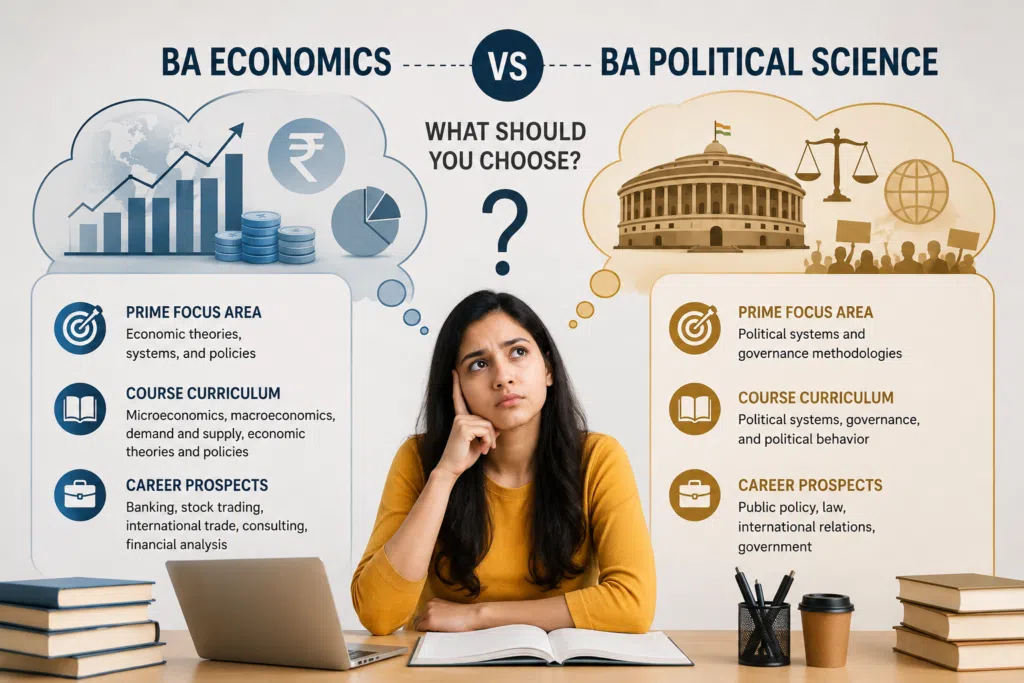
| Key parameter | BA Economics | BA Political Science |
|---|---|---|
| Prime focus area | Economic theories, systems, and policies | Political systems and governance methodologies |
| Course curriculum | Microeconomics, macroeconomics, demand and supply, economic theories and policies | Political systems, governance, and political behavior |
| Career prospects | Banking, stock trading, international trade, consulting, financial analysis | Public policy, law, international relations, government |
So, which is better economics or political science after 12th? It genuinely depends on where your interests and long term goals lie. If numbers, markets, and financial systems excite you, Economics is likely the stronger fit. If governance, policy, and international affairs interest you more, Political Science is probably the better direction. Neither option is objectively superior when it comes to which is better economics or political science after 12th. The right answer comes down to what you enjoy studying and where you see yourself working over the next decade.
Conclusion
Whether you choose BA Economics or Political Science ultimately comes down to personal interest, academic strength, and career goals. The decision can feel tricky at first, which is why we have laid out the curriculum, career paths, and salary expectations for both here.
If you would rather pursue your undergraduate degree online, from the comfort of your home, Sikkim Manipal University (SMU) offers an online BA degree in India after 12th arts through the Online Manipal platform. This BA combines Political Science with English and Sociology, giving students a well-rounded understanding across all three domains. It is worth noting that Online Manipal does not currently offer a standalone BA in Economics. If your interest leans toward economics specifically, Manipal University Jaipur (MUJ) offers an online BCom with a specialization in Economics, as well as an online MA in Economics for postgraduate study, both available on the same platform.
Choosing an online BA degree in India after 12th arts through SMU also means access to a UGC entitled degree recognized alongside on campus programs, along with the flexibility to study at your own pace. Compared to relocating for a regular campus program, an online BA degree in India after 12th arts lets students continue living at home while still earning a recognized qualification. After completing the program, students can go on to pursue a Master’s in Political Science or explore other specializations to deepen their expertise and strengthen their career prospects.
Sikkim Manipal University is accredited by NAAC with an A+ grade, and all its degree courses are entitled by the UGC. Programs offered on the Online Manipal platform are recognized by industry leaders, corporations, and government bodies alike.
Become future-ready with our online MBA program